Pearson Edexcel · GCSE · English Language
Reading: Non-fiction and Transactional Writing
This topic focuses on developing crucial reading skills for unseen non-fiction texts, specifically finding explicit/implicit information and synthesising evidence. It also covers transactional writing, where candidates must match their writing style to a specific form, purpose, and audience.
- 6 min read
- 3 worked examples
- 5 practice questions
- 8 key terms
Study Notes
Overview
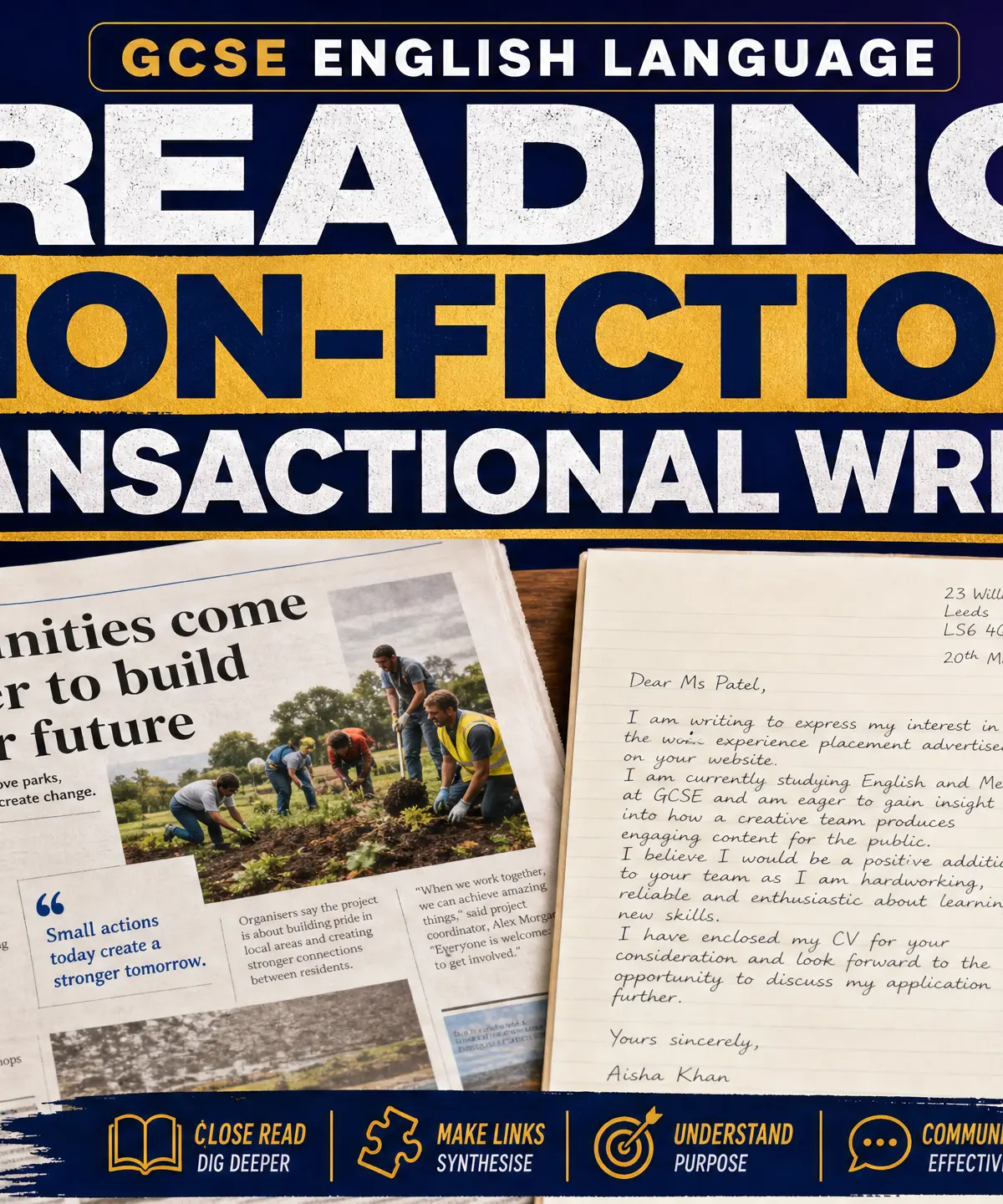
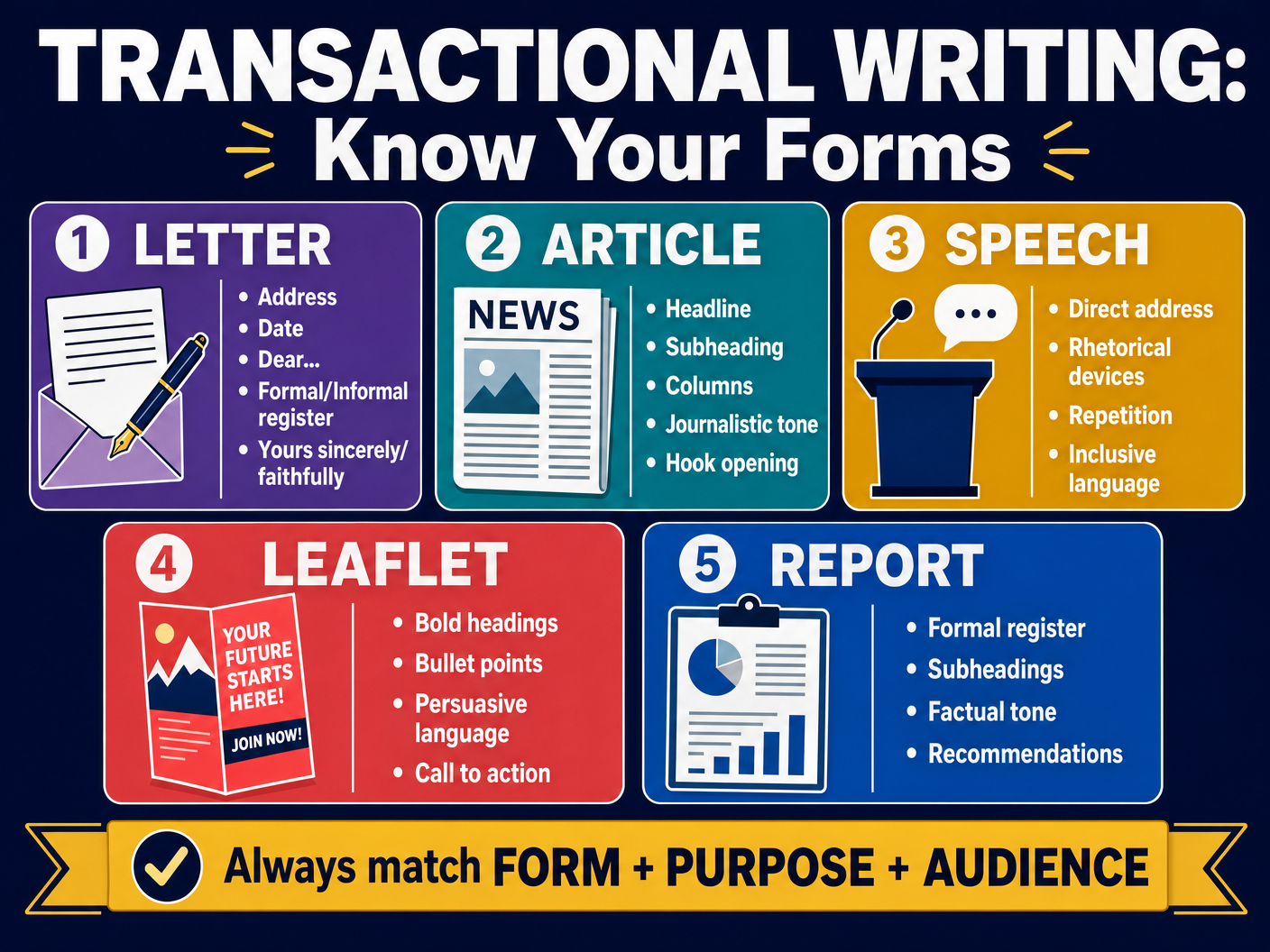
Reading non-fiction and producing transactional writing are core skills assessed in GCSE English Language. The reading section requires you to dissect unseen non-fiction texts, identifying both obvious facts and hidden meanings, while the writing section tests your ability to communicate effectively for real-world purposes (like persuading, arguing, or advising) in specific forms (like letters, articles, or speeches).

Listen to our 10-minute expert podcast breaking down the core concepts and exam techniques for this topic!
Reading Skills
Identifying Information & Ideas
Examiners test your ability to extract information accurately. This falls under Assessment Objective 1 (AO1). You must distinguish between two types of information:
- Explicit Information: Information that is directly stated in the text. There is no ambiguity. For example, 'The train departed at 8:00 AM.'
- Implicit Information: Information that is suggested or implied. You must 'read between the lines'. For example, 'He tapped his watch frantically and sighed as he stared down the empty tracks' implies he is impatient and the train is late.
When asked to list or identify explicit points, keep your answers concise. Do not waste time analysing language when the question only asks for facts.
Analysing Language
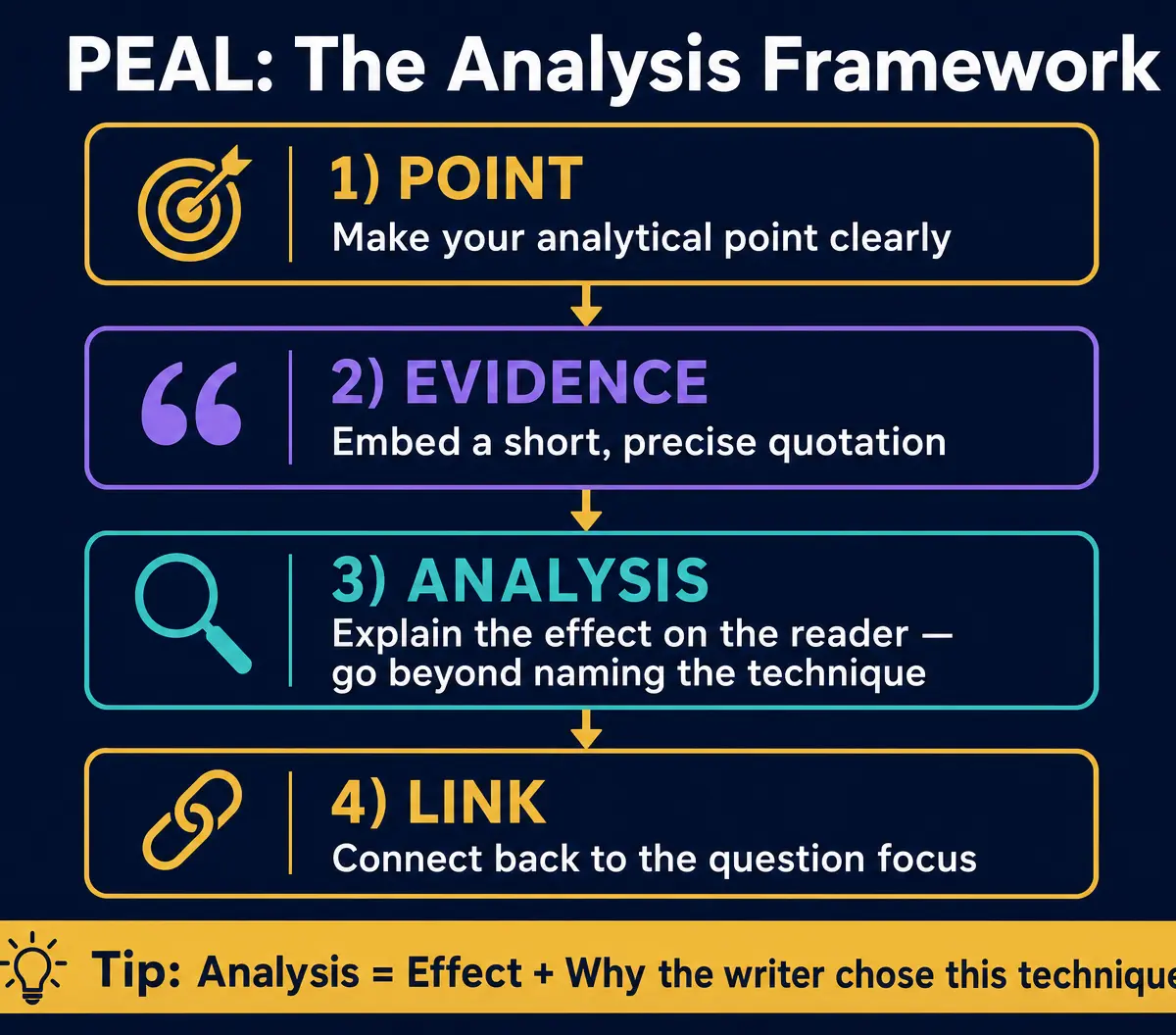
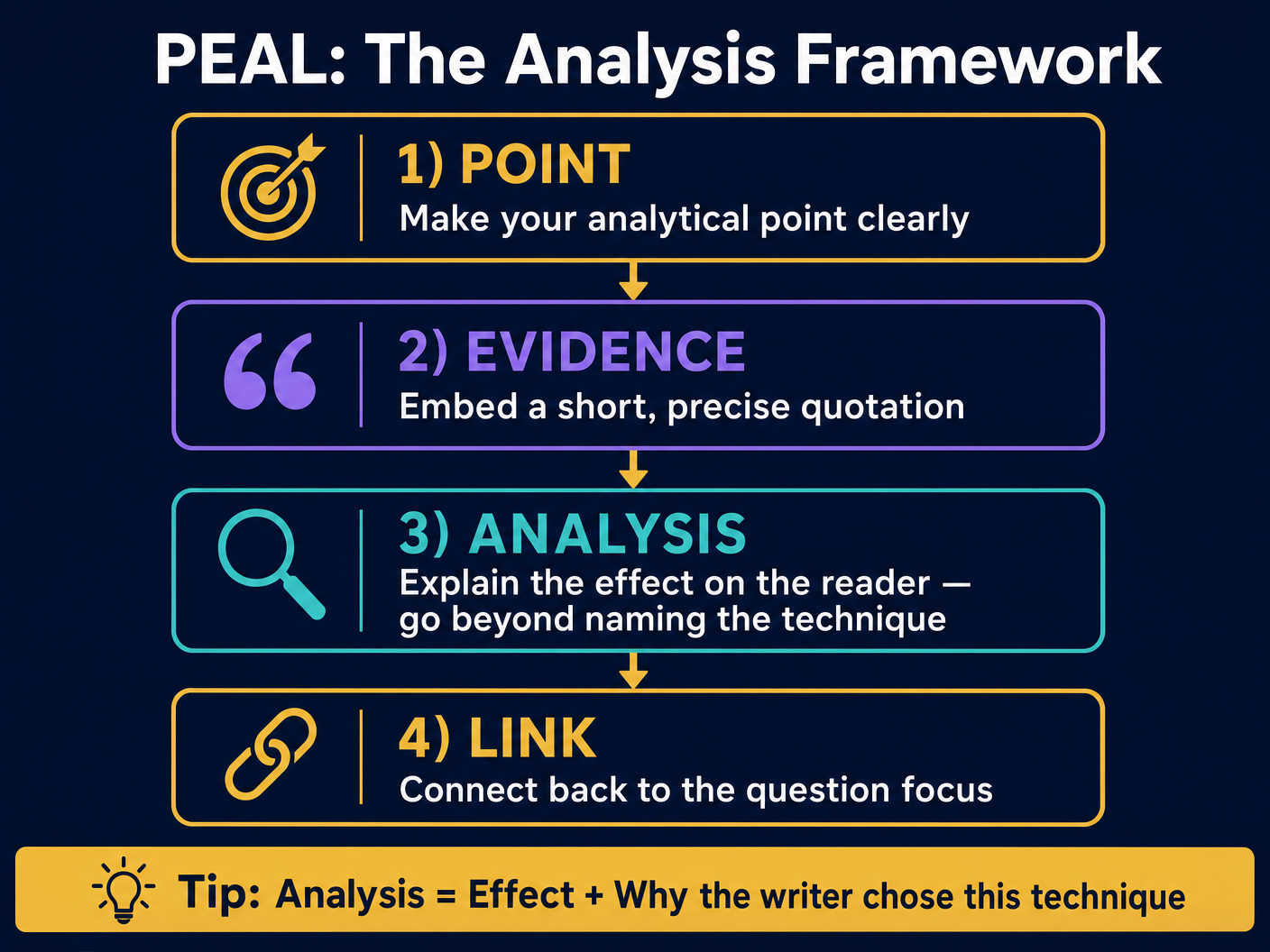
When you are asked how the writer uses language (AO2), you must go beyond merely spotting techniques. Naming a metaphor earns no marks on its own; explaining the effect of that metaphor on the reader is what examiners reward.
Key Language Features to Identify
| Feature | Definition | Effect on Reader | Example |
|---|---|---|---|
| Metaphor | Describing something as if it is something else. | Creates vivid imagery, making the description more powerful and memorable. | 'The city was a concrete jungle.' |
| Simile | Comparing two things using 'like' or 'as'. | Helps the reader visualize the subject by relating it to something familiar. | 'The wind howled like a wounded animal.' |
| Personification | Giving human qualities to non-human things. | Brings the inanimate to life, often creating a specific mood or atmosphere. | 'The angry storm pounded the roof.' |
| Semantic Field | A group of words related to the same topic. | Builds a cohesive atmosphere or theme throughout a paragraph or text. | 'Blood, wound, attack, pain' (Semantic field of violence) |
| Emotive Language | Words chosen specifically to provoke an emotional response. | Manipulates the reader's feelings, making them sympathetic or angry. | 'The defenseless puppies were left abandoned.' |
Analysing Structure
Structure (also AO2) refers to how the writer organizes the text to guide the reader's experience. You must analyse why paragraphs are ordered in a certain way, or why the focus shifts.
Key structural features include:
- Openings: How does the writer hook the reader initially?
- Shifts in Focus: Does the text move from outside to inside? From past to present? From a wide view to a narrow focus?
- Sentence Length Variation: Short sentences can build tension or emphasize a point, while long, complex sentences can provide detailed description or show a train of thought.
- Cyclical Structure: Ending the text by returning to an idea mentioned at the beginning, providing a sense of closure.
Evaluating Critically
Evaluation questions (AO4) ask for your considered opinion on a text, often responding to a statement like 'A student said... To what extent do you agree?'.
To succeed, you must:
- State a clear opinion.
- Select relevant textual evidence to support it.
- Analyse the writer's methods (language/structure) that created the effect you are evaluating.
Comparing Writers' Viewpoints
Comparison questions (AO3) require you to look at two different texts (often from different time periods) and synthesize information.
- Identify Viewpoints: What does Writer A think about the topic? What does Writer B think?
- Compare Methods: How does Writer A convey their viewpoint compared to Writer B? (e.g., Writer A uses a formal, objective tone, while Writer B uses highly emotive language).
- Synthesise: Draw connections. 'Both writers agree that the conditions were poor, but Writer A focuses on the physical dirt, whereas Writer B emphasizes the emotional toll on the workers.'
Writing Skills
Transactional/Non-Fiction Writing
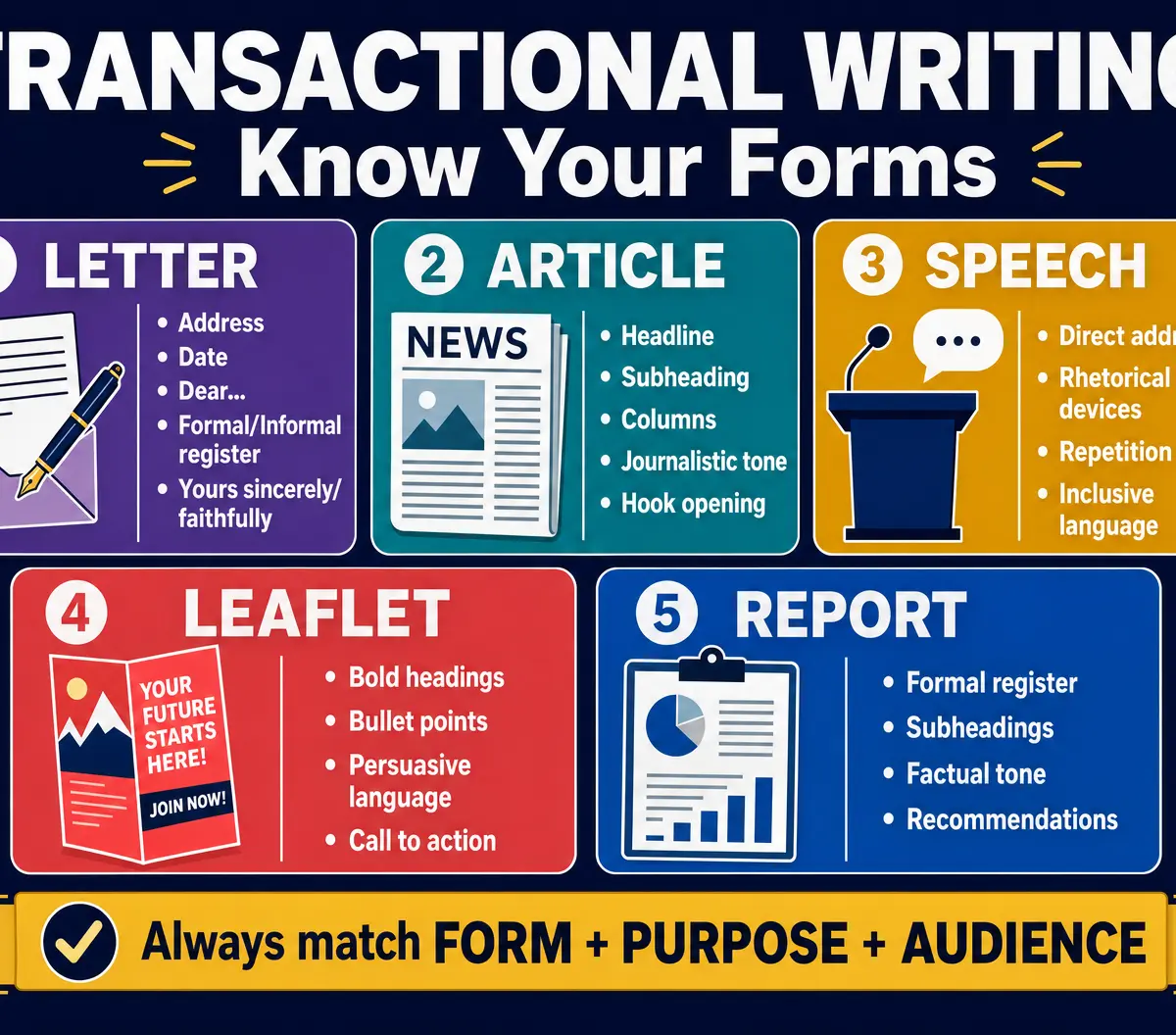
Transactional writing (AO5 and AO6) is writing with a specific, real-world purpose. The golden rule is PAF: Purpose, Audience, Form.
The AFOREST Technique
When writing to persuade or argue, use these techniques judiciously:
- Alliteration: 'Cruel, callous, and cold-hearted.'
- Facts: 'The Earth's average temperature has risen.'
- Opinions (presented as facts): 'It is an absolute disgrace.'
- Rhetorical Questions: 'How much longer can we ignore this?'
- Emotive Language: 'Innocent victims are suffering.'
- Statistics: 'Over 80% of students agree.'
- Three (Rule of): 'We must act now, act decisively, and act together.'
Technical Accuracy (SPaG)
Spelling, Punctuation, and Grammar (AO6) account for a significant portion of your writing marks (often up to 20%).
- Ambitious Punctuation: Don't just use full stops and commas. Use semicolons to link related independent clauses; colons to introduce lists or explanations; and dashes for emphasis.
- Paragraph Cohesion: Use discourse markers (e.g., 'Furthermore', 'Conversely', 'Consequently') to link your paragraphs logically.
- Vocabulary: Upgrade simple words. Instead of 'bad', use 'deplorable'. Instead of 'happy', use 'ecstatic'.
Interactive Diagrams
2 interactive diagrams to visualise key concepts
Conceptual Flow Outline
Exam Strategy Flowchart
Conceptual Flow Outline
Synthesis and Comparison Framework
Worked Examples
3 worked examples — open one to explore the question and available guidance.
Practice Questions
Test your understanding — click to reveal model answers
Read the provided extract. List four things you learn about the narrator's journey. (4 marks)
Hint: Look for explicit facts only. Do not analyse language.
How does the writer use language to describe the storm? (8 marks)
Hint: Identify techniques (e.g., personification, verbs) and explain their effect on the reader.
Both texts describe a visit to a hospital. Compare how the writers convey their different attitudes to the hospital environment. (16 marks)
Hint: Identify the attitude in Text A, identify the attitude in Text B, and compare the methods (language/structure) they use to show these attitudes.
Write an article for a broadsheet newspaper arguing that teenagers should be banned from using social media. (40 marks)
Hint: Use PAF. Form: Article (headline required). Audience: Broadsheet readers (adults, formal register). Purpose: Argue.
Write a speech to be delivered to your school assembly explaining why school uniforms should be abolished. (40 marks)
Hint: Form: Speech (needs direct address). Audience: Peers and teachers. Use rhetorical devices.